Gear & Tools
The Best eSIMs for Digital Nomads in 2026 (And How to Stay Connected Anywhere)
Staying connected on the road in 2026: the best eSIM providers for digital nomads, what to look for, and when a physical SIM is still the better option.

There was a time when arriving in a new country meant hunting for a local phone shop, pointing at a "SIM card" at someone who didn't speak your language, and spending 45 minutes on picking a plan and the setup before you could figure out where your accommodation actually was. That time is mostly over. Yayyy!
eSIMs have changed connectivity for travellers so so much. You can sort your data plan before you land, activate it from your phone, and have working internet the moment you step off the plane. For digital nomads and travellers specifically, staying connected isn't a nice-to-have. It's a work requirement. It's safety. Here's what I think is worth using in 2026.

What an eSIM Actually Is
So an eSIM is a digital SIM card built into your phone. Instead of physically swapping a chip, you download a profile from a provider and activate it. Most phones from 2020 onwards support eSIM. You can check your settings under mobile or network data to confirm.
One important thing: most phones support multiple eSIM profiles, but only one can be active at a time. You can keep your home number on one profile and switch to a travel eSIM when you need data abroad. Both coexist on the phone without physically removing anything. Easy, no?
Quick Comparison
Provider | Countries | Pricing model | Example price | Global plan | Unused data expires? | Standout feature |
|---|---|---|---|---|---|---|
Airalo | 200+ | Per plan | From ~$1/GB | Yes | Yes | Widest plan variety |
Holafly | 160+ | Per plan (unlimited) | From ~$6/7 days | Yes | N/A | Unlimited data |
UMI | 200+ | Pay-as-you-go + plans | From $2.45/GB (EU) | Yes (one eSIM, everywhere) | No, never | Balance never expires |
Saily | 150+ | Per plan + monthly Ultra | From ~$5/7 days | Yes | Yes | Built-in ad blocker |
Nomad eSIM | 200+ | Per plan | From $1.10/GB | Yes | Yes (up to 365 days) | Longest validity |
GigSky One | 120+ | Monthly subscription | 25/50/75GB per month | Yes | Monthly reset | Predictable monthly cost |
Airalo: The Most Flexible Option
Airalo is the eSIM provider that comes up most often in nomad circles, and it's earned that reputation. The app is clean, the coverage is broad, and you can buy country-specific, regional, or global plans depending on where you're headed.
Plans vary widely in price: you might pay a few dollars for a week of data in one country, or buy a regional plan covering 30+ countries for a longer stretch. The flexibility is the main draw. You're not locked into a subscription; you top up when you need to. For people who move frequently between different regions, this works well.
The limitation is that you're buying data, not a phone number. If you need a local number to verify apps or receive calls, Airalo alone won't solve that.
Download the Airalo app and use code STELLA3 for $3 off your first eSIM (:

Holafly: Best for Heavy Data Users
Holafly takes a different approach and offers unlimited data plans. For digital nomads who are video calling clients, uploading content, or working heavily from their phone connection rather than Wi-Fi, unlimited data removes the anxiety of watching your gigabytes disappear.
Coverage spans 160+ countries and customer support is available around the clock. The pricing is higher than Airalo for lighter use, but if you're regularly burning through data, the unlimited model saves money and headspace.
Worth noting: "unlimited" on any eSIM plan comes with a fair use policy. Very high usage can result in throttled speeds. For most people the limits are generous enough not to matter, but read the small print if you're planning to use it as your sole internet source for extended periods.
UMI: The Underdog Worth Knowing About
UMI doesn't get the same airtime as Airalo or Holafly, and that's a mistake. It's one of the most nomad-logical eSIM products out there once you understand how it works.
The concept is a Universal eSIM: install it once and it works across 200+ destinations without swaps, reinstalls, or messing around with new profiles every time you cross a border. You pay for data in two ways. Fixed plans work like any other eSIM provider. But the standout feature is Flow: a pay-as-you-go balance that never expires.
That last part matters more than it sounds. With most eSIM providers, unused data at the end of a trip is gone. With UMI's Flow, whatever you don't use rolls over indefinitely. For nomads who move between countries at different speeds, sometimes burning through data fast and sometimes barely using it, this is a much more honest model. Flow pricing starts from around $2.45/GB in Europe and $3.49/GB in Southeast Asia, with no speed caps and unlimited hotspot.
The app has a 4.9 rating on the App Store, and there's a reason it's popular with pilots and frequent flyers who have an even less predictable relationship with connectivity than the average nomad. It doesn't include a phone number, data only, but the flexibility of the balance model makes it one to seriously consider.
Join my VIP club using code "talksoon" and there you'll find a code for 20% off! (on your first esim)! Download the app here.
Saily: The One From the NordVPN Team
Saily is made by the team behind NordVPN, though it's a separate product and not a VPN. Worth clarifying that upfront because the association can create confusion: activating Saily doesn't automatically route your traffic through a VPN tunnel.
What it does do is come with a built-in ad blocker and web protection, which in independent testing saves around 28% of mobile data by blocking ads and trackers before they load. That's a practical data-saving feature, not just a marketing claim.
Coverage reaches 150+ countries, plans run 7 or 30 days starting from around $5, and the monthly Ultra plan offers unlimited global data with premium benefits. The app is clean, support is available 24/7, and the Trustpilot rating sits at 4.7 from over 25,000 reviews. It entered the market in late 2023 and has expanded quickly.
The main caveat is that it's still relatively new compared to Airalo or Holafly, so the track record in more niche destinations is shorter. For mainstream travel routes, it's solid.
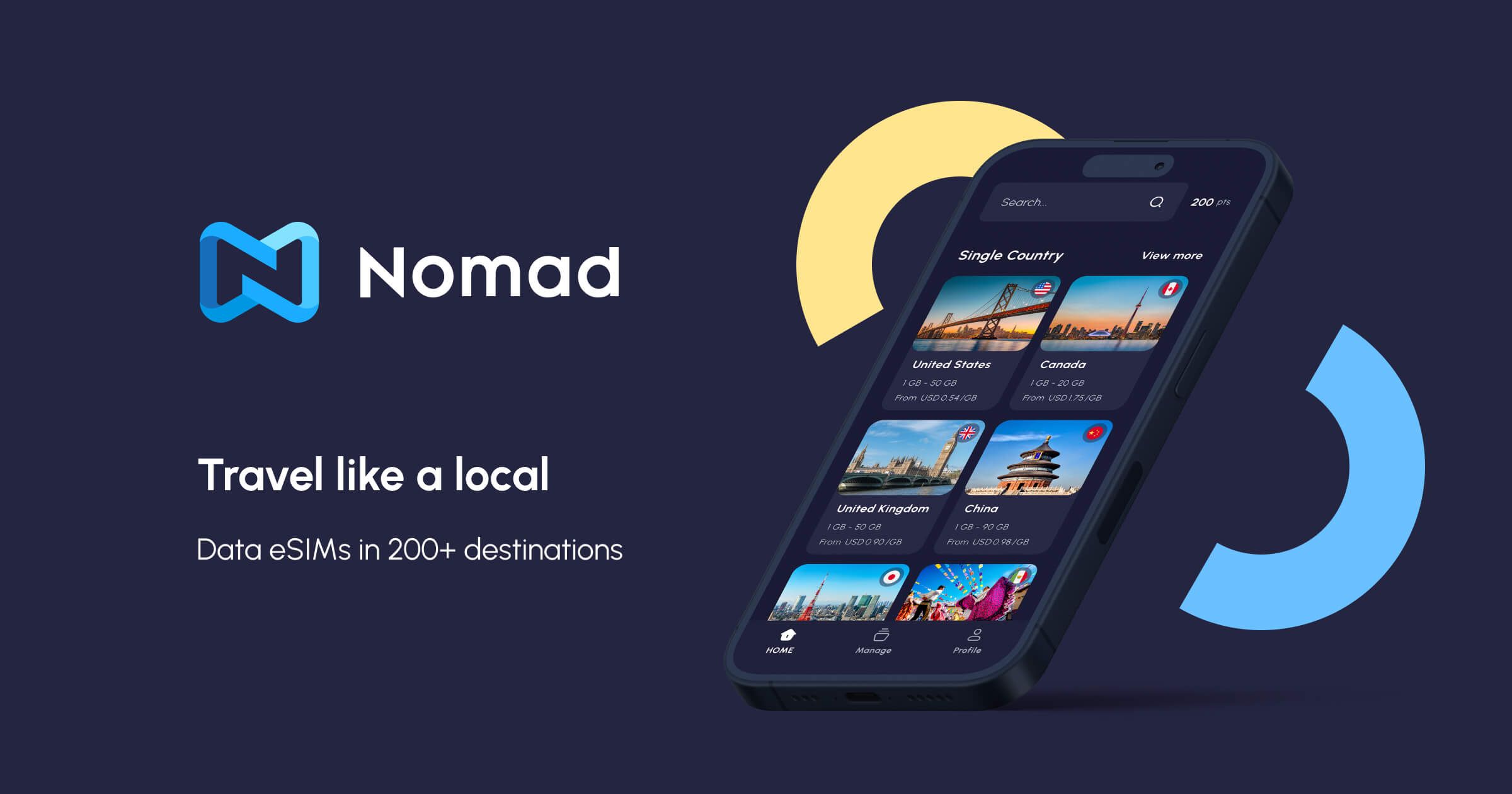
Nomad eSIM: Best for Long-Term Coverage
Nomad eSIM is worth knowing about for longer validity periods. Plans run up to 365 days, covering 200+ countries, starting from $1.10/GB. For anyone who wants to set up connectivity once and not think about it again for months, this is the cleanest option.
GigSky One: If You Want a Monthly Subscription
GigSky One offers a monthly subscription model with 25, 50, or 75GB options covering 120+ countries. If you prefer predictable monthly costs and don't want to manage per-trip purchases, this is a simple structure. It suits nomads with consistent monthly data usage more than people whose usage swings dramatically by destination.
When a Physical SIM Is Still the Better Call
eSIMs are excellent but they're not the answer everywhere. A handful of countries have restrictions on eSIM providers, and in remote areas, a local physical SIM from a local carrier often gets better signal.
China requires a physical SIM from a local carrier. Parts of sub-Saharan Africa and some smaller island nations are similarly patchy for eSIM coverage. The rule of thumb: check whether your provider covers your destination before you arrive, and have a plan B.
Local SIMs in many countries are also extremely cheap and fast to set up. In Thailand you can get 30 days of data and calls for a few hundred baht at the airport. In some situations, buying local still makes more sense than relying on a global eSIM.

A Few Practical Things Worth Knowing
Always download and activate your eSIM before you leave the country or area where you have reliable Wi-Fi. Activating it at the airport works fine; activating it while you're already offline doesn't.
Keep your home SIM active on a second profile or physically in the phone if it supports dual SIM. Some services and banking apps are tied to your home number for two-factor authentication, and losing access mid-trip creates unnecessary friction.
If you're relying on your phone connection for work, carry a power bank. Hotspotting drains battery fast. Running out of battery and data simultaneously in an unfamiliar place is a specific kind of nightmare.
For more on staying secure while you travel, the digital nomad cybersecurity guide covers what to know about working on public networks. And if you're still sorting out the rest of your nomad setup, the best backpacks for digital nomads in 2026 is a useful companion.
The Short Version
For most nomads, Airalo is the default: flexible, affordable, and widely available. Add Holafly if you burn through data. Try UMI if you want a pay-as-you-go balance that never expires and hate wasting unused data. Use Saily if the built-in ad blocker and data-saving features appeal to you basically. Consider Nomad eSIM or GigSky for longer validity or subscription structures. Check local SIM options before ruling them out, especially in Asia!
I know there are a lot of options, but just try some out and pick your fav. It's truly not as complicated as it might sound.
And please please please, sort your internet situation before you need it, not when you're standing in arrivals with no signal and a dead phone. And yes, i'm talking from experience…
Thinking about traveling?
If you're not quite there yet, start with the free digital nomad starter pack. It covers the basics of going location-independent without the overwhelm. Grab it at stellasentiero.com/newsletter. Comes with weekly travel deals, cool trips, giveaways and remote job opportunities! 💌
Follow to learn & travel more
Simple guidance and ideas to earn remotely and start traveling the world